Monday, February 14, 2022

Dragons - Chapter 81 (DRAFT)

I tried to focus on my work. In times past, work was always a kind of refuge for me. A thing I could do where progress could always be made. Even if it was nothing more than entering numbers in a spreadsheet, editing an article for our newsletter, or sending out a batch of emails and tracking the responses that came back -- they were all definable and executable tasks, boxes to check, steps to advance, goals to achieve.

But now there were so many things on my plate that there was no real refuge to be found. I kept a document on my computer desktop that served as my on-going “To Do” list, and as I opened it that morning I remember it spanning more than four pages of single-spaced 12-point type. Some of it was organized by project category, but much of it wasn’t. A whole extra page had just been added, representing the immediate tasks that Gerald had left behind, unceremoniously given to me in the same manner I had inherited items from Michael, and before that from Susan. 

It seemed like the first thing I should do was go through Gerald’s list and try to organize it and then prioritize it, line it up by project against the projects I already had and try to decide how to cadence them all in a way that the most pressing things got done first. But that seemed overwhelming to me, so I picked something simple off my existing list and began tackling that, far preferring to get something, anything checked off rather than try to comprehend the totality of the challenge I was facing.

As I worked, keystrokes and mouse clicks the only sound emanating from my workspace, I kept noticing a kind of glitch on my monitor. There was a little fuzzy patch on the screen. Any set of characters that tried to penetrate it got smudged beyond recognition. But the phenomenon was fleeting in a strange kind of way. When I tried to focus my attention on it, it seemed to slide off to  the side, but still there, wiggling and wavering in my peripheral vision.

I looked up and away from the monitor, and realized it wasn’t a computer malfunction at all. Staring up into empty space, it was still there, stuck against my blank office wall. And, frighteningly, when I closed my eyes, it was even still there, seemingly projected against the dark insides of my eyelids. Worse, it seemed to be getting bigger, now curving down into a tremendous crescent that obscured fully a fourth of my optical field.

What the fuck? Was I having a stroke? A brain aneurysm?

I got up from my desk, and had to steady myself. I was dizzy and I had a headache. I left my office and began making my way down the hall, trailing my hand along one wall to keep myself on course and eventually made it to the office restrooms, glad that one of the single, unisex rooms was unoccupied. Not knowing who might have seen my awkward journey nor what they might have thought about it, I closed and locked the door behind me and made my clumsy way over to the mirror.

I tried to look at myself, tried to look into my own eye, convinced that there would be the bright red splotch of broken blood vessels there, but the visual distortion was now so great that I couldn’t see anything clearly. I was dizzier than ever, and I fumbled and stumbled my way over to the toilet and sat down on its lowered seat.

I closed my eyes and leaned my head as gently as I could against the cold tile wall next to the toilet. I still had no idea what was happening to me, but was now too disoriented and experiencing too much nausea to seriously contemplate any wild speculations. The shimmery waves of light and shadow continued to pulse and surge in the darkness of my tortured solitude, and I began to lose all sense of my body in space. Was I sitting upright? Was I laying down? Was I spinning helplessly through yawning space? I couldn’t really tell, but I was suspecting more and more that it was the latter.

An intense way of nausea hit me and nearly vomited. Without opening my eyes -- it was too bright and painful to even open them a crack -- I slid myself down onto the floor between the wall and the toilet, pushed the seat up, and hung my head into the bowl. Without willing it, I started to retch -- once, twice, three times, each heave causing bright bursts of pain in my throat, in my neck, at my temples, and across the top of my head, but nothing but flimsy strands of mucus came up and into my mouth. When the retching was finished, I tried spitting them into the toilet bowl, but left most of the expulsion hanging off my chin and bottom lip.

I was dying. I had never experienced anything like this before, had no idea what it was, and found myself reasonably convinced that I was dying. The unisex bathroom was going to be my final resting place. Eventually, someone would have to break down the door and cart my mortal remains away.

Suddenly, there was a knock at the door. “Hello?” an unrecognizable voice said. “Is somebody in there?”

“I’ll be out in a minute!” I heard my own voice respond, exactly as if things were normal, as if it was simply the custodian, checking to see that the room was unoccupied before coming in to clean it.

I didn’t bother listening for the person -- whoever it was -- to knock or speak again. I didn’t even want to think about the fact that I was at the office, and that at some point, assuming I didn’t actually die, I would have to go back out there and face a group of mostly strangers and antagonists with my own overwhelming and undisclosed weakness. I suddenly had a vision of myself laying prostrate in front of Mary, fluids leaking from my orifices, begging her to help me, for the love of God, to call an ambulance.

Fuck that. I remembered the cell phone in my pocket. I wasn’t able to do anything with it, but I remembered it was there. If I should start to feel better, I realized, I might be able to pull it out of my pocket, call Jenny, and ask her to come get me. But how would she get me? She couldn’t come here and carry me out. I’d have to find a way to crawl downstairs without anyone seeing me. Crawl down to the parking garage and get in her car. I could do that. Couldn’t I?

All this thinking was making things worse. I dry heaved again, and then rested my head on the lip of the toilet bowl. Willing my worrying brain to be silent, and focusing only on pulsing flashes that continued unabated on the inside of my eyelids, I zoned out, marking neither the passage of time nor my chances for a positive outcome.

Slowly, imperceptibly, the symptoms began to abate. At some point, I was able to open my eyes a bit, and could actually make out objects in the center of my vision and at the appropriate focal length. Experimentally, I lifted my head up and leaned myself back against the bathroom wall. I looked at my watch, trying to get a sense of how much time had passed, but since I didn’t mark the time I came in, it was difficult to come up with a precise estimate. Twenty minutes maybe? Surely no more than a half hour.

Now I did fish my phone out of my pants pocket. Flipping it open and squinting at it with one partially-opened eye, I pushed the necessary buttons to make my home phone ring. I placed it against my ear and waited patiently for Jenny to answer.

After four rings, our home answering machine picked up. I hung up on my end, and made the difficult dialing maneuver again. I got four more rings, and then the click of the answering machine picking up again.

Okay. Fine. I’m going to have to do this myself, then. I can do it. At least I think I can.

I did not move for at least ten more minutes. By that time I could hold both eyes partially open, and felt strong enough to push myself back up to my feet. This I shortly accomplished, and weakly made my way over to the sink. I splashed some water on my face. I dried my hands on some paper towels. I straightened my shirt as best I could.

Here goes.

I had only one objective in mind. Make it back to my office. Once there, I would re-evaluate my next step. Thinking too far ahead felt paralyzing. It was simpler, and somehow more achievable, if I only attempted one thing at a time.

Slowly, I opened the bathroom door. The light was even brighter outside and at first I had to shrink away from it. But I pushed myself forward. Thankfully, there was no one in the short corridor immediately outside the restrooms, and I used that space to carefully regulate my gait so that I could make it down the major thoroughfare without attracting any attention.

Or so I thought.

“Alan?” It was Ruthie. I was having trouble holding my head up, but I recognized the blouse and flouncy skirt. “Alan, are you all right?”

“No,” I said, seeing no reason to lie, and no reason to stop my forward progress. “No, I’m not feeling well. I’m going home.”

She reversed direction and began walking beside me. I felt her grip on my arm as I stumbled into the wall and stopped. Goddammit, the lights were just too bright out here. When I cracked my eyes open even a little, it felt like lightning shooting into my brain. Another wave of dizziness overcame me, and, like a marionette with its strings cut, I crumpled to the floor.

“Alan!” I heard Ruthie say, but I did my best to block her out, too. Even the sound of her voice hurt, and it felt like the only way to respond was to try and crawl inside my own navel. In my misery, I was no longer worried that I was going to die. More than anything else, I pathetically hoped that someone would kill me.

+ + +

“Dragons” is a work of fiction. Names, characters, businesses, places, events, locales, and incidents are either the products of the author's imagination or used in a fictitious manner. Any resemblance to actual persons, living or dead, or actual events is purely coincidental. For more information, go here.

This post first appeared on Eric Lanke's blog, an association executive and author. You can follow him on Twitter @ericlanke or contact him at eric.lanke@gmail.com.

Image Source

http://lres.com/heres-why-amcs-need-to-pay-close-attention-to-looming-regulatory-changes/businessman-in-the-middle-of-a-labyrinth/


Monday, February 7, 2022

The Witches of Eastwick by John Updike

This is what I call a prose novel -- something that can be delightful to read for its turns of phrase and picturesque phrasings -- but which, in the final analysis, seems to be more about its prose than its plot, pacing, or purpose.

Here’s a taste from the novel’s opening pages.

She returned to putting up Mason jars of spaghetti sauce, sauce for more spaghetti than she and her children could consume even if bewitched for a hundred years in an Italian fairy tale, jar upon jar lifted steaming from the white-speckled blue boiler on the trembling, singing round wire rack.

“She” is Alexandra Spofford, one of the three titular “witches” of Eastwick.

It was, she dimly perceived, some kind of ridiculous tribute to her present lover, a plumber of Italian ancestry. Her recipe called for no onions, two cloves of garlic minced and sautéed for three minutes (no more, no less; that was the magic) in heated oil, plenty of sugar to counteract acidity, a single grated carrot, more pepper than salt; but the teaspoon of crumbled basil is what catered to virility, and the dash of belladonna provided the release without which virility is merely a murderous congestion.

Alexandra is a middle-aged widow, the matriarch of her coven of two other similarly situated women, and her “magic” is more typically expressed in Updike’s stylized symbolism than in more overt actions of witchcraft.

All this must be added to her own tomatoes, picked and stored on every window sill these weeks past and now sliced and fed to the blender: ever since, two summers ago, Joe Marino had begun to come into her bed, a preposterous fecundity had overtaken the staked plants, out in the side garden where the southwestern sun slanted in through the line of willows each long afternoon. The crooked little tomato branches, pulpy and pale as if made of cheap green paper, broke under the weight of so much fruit; there was something frantic in such fertility, a crying-out like that of children frantic to please. Of plants tomatoes seemed the most human, eager and fragile and prone to rot. Picking the watery orange-red orbs, Alexandra felt she was cupping a giant lover’s testicles in her hand.

Maybe you get the point. Updike has a theme, and he’s going to squeeze every last drop of tomato juice out of it -- trying to delight you with his prose at the same time he’s clobbering you over the head with it.

She recognized as she labored in her kitchen the something sadly menstrual in all this, the bloodlike sauce to be ladled upon the white spaghetti. The fat white strings would become her own white fat. This female struggle of hers against her own weight: at the age of thirty-eight she found it increasingly unnatural. In order to attract love must she deny her own body, like a neurotic saint of old? Nature is the index and context of all health and if we have an appetite it is there to be satisfied, satisfying thereby the cosmic order. Yet she sometimes despised herself as lazy, in taking a lover of a race so notoriously tolerant of corpulence.

The whole novel is like this. It weaves its spell over you, but when it’s finished you have to sit back and wonder what the heck it was all about.

It seems to be saying something. The Wikipedia entry I read on it talks about the controversy with which it was met. Did Updike write a feminist novel? Alexandra and her coven, after all, rise in their power only after their husbands have been dispatched. Or did he write a sexist one? After all, Alexandra and her coven succumb to the wily charms of Darryl Van Horne (so clearly the metaphoric devil in this allegorical tale that one barely needs to mention it). Or did Updike write a satirical novel? After all, Alexandra and her coven only rise and fall amidst the bevy of blinkered characters that populate Eastwick, a New England town that can only exist in Updike’s imagination because its patterns and passions must exist in his actual experience.

Yes. In the final analysis, I would have to say that Updike wrote exactly the kind of novel you might want this one to be. Feminist. Sexist. Satiric. Pick your poison -- or perhaps your witch’s potion. It’s all there for you to find if you look hard enough.

+ + +

This post first appeared on Eric Lanke's blog, an association executive and author. You can follow him on Twitter @ericlanke or contact him at eric.lanke@gmail.com.

Monday, January 31, 2022

Dragons - Chapter 80 (DRAFT)

My phone was ringing when I got back to my office. I rushed to pick it up on the third ring that I heard, not knowing how long it had been ringing before that. 

“Hello, this is Alan Larson.”

“Alan. This is Paul Webster calling. How are you?”

I felt my heart stop. Literally. There passed probably five seconds of silence where it would either decide to start beating again or I would flop over onto the floor of my tiny office.

“F...fine, Paul. How are you?”

“Well, I was a lot better a week ago. I was hoping you and I could have a talk about some of the things that have transpired since then.”

“S...sure,” I said. “Give me a minute to close my office door.”

“That’s probably a good idea.”

I clunked the phone down on my desk and walked over to my door like a zombie. While I was there I took a moment to look out through its cracked glass to see people arriving and getting settled into their cubes. Among them I saw Caroline Abernathy -- the young woman who was almost fired the day they terminated Amy Crawford, who needed rescuing from the clutches of Wes Howard in the dark basement of Club NOW. She was wearing another one of those droopy sweaters she always wore, the tissues for her perennial runny nose tucked reassuringly into its pockets and sleeve cuffs. She wasn’t talking to anyone, simply easing herself into her ergonomic chair and into her lot for the day and suddenly, insistently, I wanted to be her, to give up everything I had and everything I was to be her, sitting alone and unbothered at my desk with my long, straight hair hanging around my face for the next eight hours. That had to be better than what waited for me on the telephone, and whatever would come after that, and after that.

“Hello?”

“Yes, I’m still here, Alan.”

“What do you want?”

“Just a few minutes of your time.”

“You got them.”

Paul paused, probably uncertain about how to proceed. My tone so far had been hostile. I certainly wasn’t going to make this easy for him.

“Well, Alan,” he said slowly. “How are you doing these days?”

“I’m fine.”

“Really? That’s not what I hear. From what I’ve heard, it sounds like your world is caving in around you.”

I did not respond. It was all I could do to sit in my chair and force my heart to slow down.

“Alan?”

“Yes, I’m here.”

“That’s a little more like it, isn’t it? First it was Susan Sanford, and then Michael Lopez, and now Gerald Krieger. There all leaving, moving on to better things, perhaps, and there you stay, taking on more than you can possibly handle.”

His voice was strangely intimate in my ear, almost like my own cricket conscience chirping its secret thoughts and worries. 

“How do you think it’s going to end?”

I closed my eyes. “Is there something I can do for you, Paul?”

“Actually, yes, Alan. There is. I was hoping you would keep me in the loop about what is going on in the organization.”

“Which organization? Yours or mine?”

“Well, both actually,” he replied, evidently understanding that I was drawing a distinction between Mary’s company and the non-profit organization whose leadership he had just been forced out of.

“Why would I do that? Mary told me you were finished.”

“Mary doesn’t know half of what she thinks she does. I’m not finished. She is.”

I opened my eyes and was shocked to see Mary standing on the other side of my glass door. Her back was partially towards me, engaged in some kind of conversation with Don Bascom. Whether she was on her way to my office or just passing by when Don stopped her, I didn’t have any idea.

“Alan, did you hear what I said?”

“Yes, I heard you, Paul. You said that Mary was finished.”

“She is. She doesn’t know it, yet, but, I promise you, she’ll be the next one to go. You should think about where you want to be standing when that happens.”

I had no response to that. I was frankly more focused on Mary and Don, having what appeared to be a hushed and fairly serious conversation right outside my office. 

“Paul, I have to go now.”

“Wait. Don’t hang up. What you do next may very well determine if you’re going to be in or out when the shit comes down. If you play your cards right, you may be the one sitting in that corner office of hers.”

Mary suddenly turned, her conversation with Don ending, his bulky form lumbering off and out of view. Her hand reached out to grasp my door handle.

“Paul, I need to go now.”

“Wait! At least tell me…”

His voice drifted off as I dropped the receiver back in its cradle, executing the movement just as Mary pushed my door open and stepped halfway into the room.

“Alan, do you have-- Oh, sorry. Were you on the phone?”

“Just finished up,” I said as pleasantly as I could. “What’s up?”

“Who was that?” she asked, now stepping fully into my office, but not closing my door behind her.

In the split second I was given to make the biggest decision of my day I decided to lie. “Samir Mahdi,” I said, picking someone who was on my list to call that day, a minor committee chair that would be attending the leadership conference next week. “He had some questions about the event.”

Mary looked at me quizzically only for a moment. “Have you called Wes Howard, yet?”

“No,” I said. “He said over email that he would be available later this afternoon. I’m planning to call him around two.”

Mary nodded. “Okay. Just make sure you connect with him today. He has some changes to the invitation list that will need to be dealt with. Whatever he says, just do it, okay?”

“Sure,” I said, forcing my smile to grow wider. “He’s the new boss, right?”

I meant it light-heartedly, but Mary’s reply was deadly serious. 

“Yes. He is.”

I kept smiling, nodding my head like the petrified idiot I was.

+ + +

“Dragons” is a work of fiction. Names, characters, businesses, places, events, locales, and incidents are either the products of the author's imagination or used in a fictitious manner. Any resemblance to actual persons, living or dead, or actual events is purely coincidental. For more information, go here.

This post first appeared on Eric Lanke's blog, an association executive and author. You can follow him on Twitter @ericlanke or contact him at eric.lanke@gmail.com.

Image Source

http://lres.com/heres-why-amcs-need-to-pay-close-attention-to-looming-regulatory-changes/businessman-in-the-middle-of-a-labyrinth/


Monday, January 24, 2022

Rodin by David J. Getsy

I’m sure I picked this up at one of the many art museums I like to visit when I’m traveling. Which one, I don’t remember. Perhaps it was the Rodin Museum in Philadelphia itself, but my dim memory suggests that it was disappointedly closed on the day I had reserved for my visit there. Perhaps, then, it was at the Philadelphia Museum of Art down the street.

The subtitle of the book is “Sex and the Making of Modern Sculpture,” and, indeed, one of the two long essays that the book contains deals effectively with the sexual themes that subsumed much of this famous sculptor’s work. My favorite anecdote from this study deals with Rodin’s famous and monstrous sculpture of Honoré de Balzac, which not only intentionally looks like an enormous phallus in silhouette, but which, based on the early studies Rodin experimented with, secretly has Balzac gripping his own erect penis (the seat of both sexual virility and creative genius in Rodin’s idiom) under the voluminous robes that otherwise drape his towering torso. 

But far more interesting to me are the parts that deal with the second part of the subtitle: the making of modern sculpture. I have personally always been drawn to sculpture as an artform, and to Rodin’s work specifically. That probably explains my failed attempt to visit the Rodin Museum, and this book certainly explains what Rodin was trying to accomplish and, perhaps, why his work is so pivotal in art history. Yes, his work is sexual, but more importantly, his work is abstract.

All sculptures operate between image and object, between representation and materiality, but Rodin’s intervention into the discourse of nineteenth-century sculptural praxis was to sacrifice verisimilitude, representational consistency, and the coherence of the figure itself in order to let his acts of making overtake the object even after the form had undergone material transcriptions and been the product of other hands. Rodin deployed signs of his presence that would survive the translations of a sculpture across materials but that always pointed back to the fact that the sculpture was made by him, establishing its scene of creation as the primary source of significance for the viewer.

The author is here referring to the many material translations that sculptural works of art often went through in Rodin’s day -- from the original clay to plaster to bronze or to marble -- before they would be displayed and viewed by the public. Through those processes, subtle changes would sometimes intentionally and sometimes not creep into the work, obscuring the original artist’s intent. In putting his marks on the work that could not be obscured, Rodin was making sure not only that his audience would know his work when they saw it, but that they would place the emphasis of their attention on his act of creation rather than on the finished piece. 

This is partly why so much of Rodin’s work shows figures either dismembered or emerging half-formed from the very lumps of clay or blocks of stone from which Rodin conjured them. Accurate representation of an image was not what mattered to Rodin. What mattered was his sensual acts of artistic creation. And this, the author argues, is most appropriately seen as Rodin’s seminal contribution to modern art.

Ultimately, what I am arguing is that Rodin’s contribution to modern sculpture was not only the seeds of abstraction, which is how his fragmentation of the body and fractured surfaces have often been interpreted. Subsequent sculptors did interpret this as a stylistic attitude toward verisimilitude, but Rodin’s strategy was more complex. It involved redirecting the viewer’s attention from image to object as the site at which his hand would be most visible. The point is not that the marks are “fake” but that their emphatic overlay on the sculptural object -- across its material transcriptions -- effects a shift in what the viewer looks for in the sculptures. This is the basis of Rodin’s “liberation” of sculpture and what has been called the demise of the tradition of the statue. Simply put, after Rodin, there were, increasingly, sculptures, not statues -- that is, objects, not images. Rodin’s performative marks strategically masquerade as direct traces in order to convince the viewer that this untouched object had been touched by him.

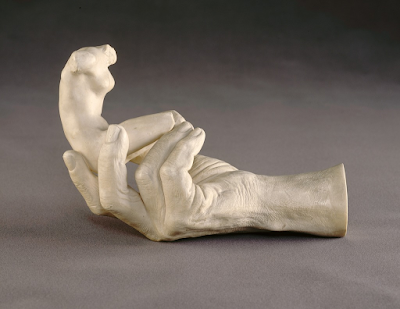
Perhaps nowhere is this juxtaposition between image and object -- between statue and sculpture -- and the artist’s role in distinguishing between the two more apparent than in the “Hand of Rodin with Female Figure,” and kind of image/object hybrid that Rodin created in 1917. Reproduced here…

...one can easily see why Getsy chose it as the cover image for his book. Rodin’s mastery of both styles are aggressively on display -- the hyper-realistic hand, modeled after his very own, gently cradling a lumpy, broken, but still clearly feminine torso. Here the artist and his art are shown in Rodin’s preferred way, telegraphing to the viewer not only what he has done, but what he is capable of.

+ + +

This post first appeared on Eric Lanke's blog, an association executive and author. You can follow him on Twitter @ericlanke or contact him at eric.lanke@gmail.com.


Monday, January 17, 2022

Dragons - Chapter 79 (DRAFT)

The rest of that Friday, and then Saturday, and then Sunday passed with an unremarked numbness. I did things. I spoke to my wife. I played with my son. I did my share of the housework. I ate my food. I took my showers. At the end of each day I went to sleep, and each morning I woke up. And throughout it all I tried to keep my mind off of what was waiting for me back in the office. I tried and I failed. No matter what I did, no matter how I tried to occupy myself and my mind, nothing could keep those dark and desperate thoughts far from my consciousness, and they cast their fretful and numbing pall over everything I did.

Only two things from that long weekend do I remember distinctly. The first was the phone call I placed back to Julie Prescott, Steve Anderson’s assistant, in order to set a day and time for my conversation with him the following week. Miss Prescott was a champion of pleasant efficiency, genuinely glad that I called, and expressing her professional concern that we find the best possible time for me and Mister Anderson to connect on our important business. It was no trouble at all, quickly resolved by a close comparison of two calendars, one in my home and the other on her desk in far off Philadelphia. Tuesday? Yes? Tuesday afternoon? At 2 P.M.? Eastern? Yes, that will work. That will work splendidly.

The second was listening to the voicemail that had been left for me by someone in the office, which I intentionally did not listen to until much later in the day on Friday. I had, after all, called in sick, and had to at least pretend that I was unable to engage in my professional responsibilities.

Perhaps not surprisingly, the voicemail was from Bethany, her hushed and mousy voice apologizing for disturbing me, wishing me a speedy recovery from whatever was ailing me, and pleading with me to give her a call as soon as I was able, even if that meant over the weekend. It was Wes Howard. Always and forever, it seemed, it was Wes Howard. He was making trouble and Bethany needed my help, needed me to do something about it. She left a lot of details on the voicemail, but I had trouble focusing on them; wishing, preferring, that I could just turn all those details into vapor and let them blow away on the wind.

Her voicemail was one of the things that hung over me all weekend. I was determined not to actively engage in whatever nonsense it represented until I was back in the office on Monday and to put it entirely out of my mind. I was only successful in doing the first thing.

She cornered me early on Monday morning, much as I should have expected.

“Are you all right?”

We were standing in the breakroom, me just closing the fridge on my sack lunch. “Yes, much better,” I said, remembering to pretend that I had been sick on Friday. “Thanks.”

“What was it? The flu?”

“I don’t know,” I said. “Migraines, maybe. I just couldn’t get myself out of bed. Dizzy and nauseous. I slept most of the day.”

I don’t think it was intentional, but she was standing in a position that effectively prevented me from leaving the room. Her arms were folded across her chest and she seemed to be glaring at me.

“Did you get my voicemail?”

“Yeah,” I said, trying to dissipate her accusatory tone with feigned innocence. “I didn’t see it until Saturday, and we were wrapped up most of the weekend in family matters. I figured we would talk about it this morning and come up with a game plan.”

“I asked you to call me,” she said pointedly. “I was waiting all weekend. Goddammit, I needed you to call me, Alan.” She looked like she was about to cry, her eyes shining and her lower lip quivering.

“I’m sorry,” I said quickly, self-consciously looking around to verify what I already knew -- that no one else was in the breakroom with us. Knowing that someone could walk in at any moment I suppressed an innate impulse to touch her -- to caress her shoulder or, God forbid, to hug her -- to comfort her in some way. Reacting negatively to the impulse, I turned suddenly cold. “I was busy, and I figured we would talk about it today. What’s the big deal?”

The look she gave me could only be described as horrified. She teetered on the edge of snapping back at me, but pulled her anger back when Angie Ferguson suddenly entered the room, an oversized lunch thermos -- the kind only arctic explorers would use -- clutched tightly in her pudgy hands.

“Good morning,” she said, navigating easily around us and pulling open the refrigerator door.

“Good morning,” I said absently as I maintained eye contact with Bethany. The look on her face turned quickly from anger to betrayal.

“Good morning,” she said icily, and then left the room.

“Is she all right?” Angie asked me.

“Yeah,” I told her. “She’s just under a lot of stress right now.”

Angie nodded. “We all are,” she said matter-of-factly, and then barreled her way out of the room.

I was left alone with a choice. Go and apologize to Bethany, ask her to share her secret fears with me, and take the burden of those fears off her shoulders and place it on mine; or go back to my office and press my nose to the grindstone perpetually waiting there for me.

I chose the latter.

+ + +

“Dragons” is a work of fiction. Names, characters, businesses, places, events, locales, and incidents are either the products of the author's imagination or used in a fictitious manner. Any resemblance to actual persons, living or dead, or actual events is purely coincidental. For more information, go here.

This post first appeared on Eric Lanke's blog, an association executive and author. You can follow him on Twitter @ericlanke or contact him at eric.lanke@gmail.com.

Image Source

http://lres.com/heres-why-amcs-need-to-pay-close-attention-to-looming-regulatory-changes/businessman-in-the-middle-of-a-labyrinth/


Monday, January 10, 2022

Wizard’s First Rule by Terry Goodkind

I may have mentioned this before: I read a lot of fantasy novels as a teenager. Back in the day, my go-to was Piers Anthony. I didn’t read everything he wrote, but looking at his Wikipedia page today, I can confidently check off the major portions of the Battle Circle, Xanth, Tarot, Apprentice Adept, Incarnations of Immortality, and Bio of a Space Tyrant series. In fact, looking even closer at his Wikipedia page, I would estimate that I fell off the Piers Anthony wagon around 1988 -- and that he has clearly been writing a whole lot since then.

But fall away I did, primarily because I felt I was outgrowing the stories I was reading. I remember his work as being clever, and exciting it’s own way, but increasingly I found myself wanting something more, something outside of what I perceived to be a fairly limited palette. 

Anthony’s output is enormous. Indeed, that same Wikipedia page I looked at says that Anthony claims that “one of his greatest achievements has been to publish a book beginning with every letter of the alphabet, from Anthonology to Zombie Lover.” And that’s kind of my point. Somewhere along that journey I began to feel that quantity was more important to the author than quality, and that in order to achieve his goals, it was necessary to stick to similar stories over and over again -- stories with simple protagonists that found themselves constantly in awkward situations (usually including their nudity and the nudity of others), and all of them finding just-so escape hatches that stretched my credulity.

But I still have fond memories. And so every once and a while I find myself in a used book store looking over the fantasy novels, hoping that I can find something in that genre that challenges my grown-up brain the way Anthony initially challenged my teenage brain.

It was with this hope that I picked up Wizard’s First Rule by Terry Goodkind. I knew nothing about it, but couldn’t help but notice the plug from none other than Piers Anthony on its paperback cover:

“A phenomenal fantasy, endlessly inventive, that surely marks the commencement of one of the major careers in the genre.” --Piers Anthony

Okay, I thought. Let’s give it a try.

For 640 pages it was a fairly lackluster fantasy adventure story. You know. The one where the hero is of humble origins, who gets swept up onto a magical journey with some mysterious strangers, and who discovers that he has latent powers that are just the thing needed to vanquish some evil tyrant. Yeah. That one. But then, on the bottom of page 641, this happens:

The pain of the sword’s magic hit him like a waterfall of icy water on naked flesh. The blade never reached her. The sword clattered to the ground as the pain took him to his knees, ripping through him, doubling him over.

Hand still on her hip, smile still on her face, she stood over him, watching as he clutched his arms across his abdomen, vomiting blood, choking on it. Fire burned through every inch of him. The pain of the magic consumed him, took his breath from his lungs. Desperately, he tried to get a grip on the magic, tried to put away the pain as he had learned to do before. It did not respond to his will. With rising panic, he realized he no longer had control of it.

She did.

He is Richard Cypher, our hero, the one of humble origins, now come to understand that he is something called the Seeker, a long-foretold conqueror of evil, with magical powers over a magical sword, which must be used sparingly because of the pain it inflicts on its user, but which can absolutely destroy Darken Rahl, the evil tyrant taking over the land.

And she is Mistress Denna, a sadistic sorceress known as a Mord-Sith, sent by the evil tyrant to capture the Seeker and to bend him to her will. 

He collapsed to his face in the dirt, trying to scream, to breathe, but couldn’t. He thought about Kahlan for an instant; then the pain took even that from him.

Kahlan is the woman he loves; also a sorceress of sorts, something called a Mother Confessor, who also has the power to end the evil, and who Richard thinks he needs to protect at all costs.

Not one of the men moved from the circle. The woman put a boot on the back of his neck and an elbow on her knee as she leaned over. With her other hand she grabbed a fistful of his hair and lifted his head. She leaned closer, the leather creaking.

Yes, Mistress Denna is dressed in leather. As described earlier: “She was sheathed in leather from neck to ground, cut to fit like a glove. Blood-red leather.”

“My, my,” she hissed. “And here I thought I was going to have to torture you for days and days before I finally made you angry enough to use your magic against me. Well, not to worry, I have other reasons to torture you.”

Through his pain, Richard realized he had made a fearful mistake. He had somehow given her the control of the sword’s magic. He knew he was in more trouble than he had ever been in in his life. Kahlan was safe, he told himself; that was all that mattered.

“Do you want the pain to stop, my pet?”

The question enraged him. His anger at her, his want to kill her, twisted the pain tighter. “No,” he managed with all of his strength.

She shrugged, dropping his head. “Fine by me. But when you decide you want the pain of the magic to stop, all you have to do is stop thinking those nasty thoughts about me. From now on, I control the magic of your sword. If you so much as think of lifting a finger against me, the pain of the magic will take you down.” She smiled. “That is the only pain you will have any control over. Just think something pleasant about me, and it will stop.

“Of course, I too will have control over the pain of the magic, and can bring it to you any time I choose, and I can bring you other pain too, as you will learn.” She frowned. “Tell me, my pet, did you try to use the magic on me because you are a fool, or because you fancy yourself brave?”

The pain let up the smallest bit. He gasped for air. She had relaxed it just enough to allow him to answer.

“Who … are … you?”

She took a fistful of his hair again, lifted his head, twisted it around to look into his eyes. As she leaned over, the boot on his neck sent a shard of pain through his shoulders. He couldn’t move his arms. Her face was wrinkled in a frown of curiosity.

“You don’t know who I am? Everyone in the Midlands knows me.”

“I’m … Westland.”

Her eyebrows lifted in delight. “Westland! My, my. How delicious. This is going to be fun.” Her smile widened. “I am Denna. Mistress Denna to you, my pet. I am a Mord-Sith.”

“I’ll not … tell you … where Kahlan is. You might as well … kill me … now.”

“Who? Kahlan?”

“The … Mother Confessor.”

“Mother Confessor,” she said with distaste. “Why in the world would I want a Confessor? It is you, Richard Cypher, that Master Rahl sent me for, no one else. One of your friends has betrayed you to him.” She twisted his head up harder, pushed her boot down harder. “And now I have you. I had thought it might be difficult, but you hardly made it any fun at all. I’m to be in charge of your training. But then you wouldn’t know about that, since you are from the Westland. You see, a Mord-Sith always wears red when she’s to train someone. That’s so your blood won’t show so much. I have a wonderful feeling I’m going to have a lot of your blood on me before I have you trained.”

She dropped his head, and leaned her full weight on her boot, holding her hand out in front of his face. He could see that the back of her gloved hand was armored, even the fingers. A blood red leather rod, about a foot long, hung loosely from her wrist by an elegant gold chain. It swung back and forth in front of his eyes. “This is the Agiel. This is part of what I will use to train you.” She gave him a smooth smile, arching an eyebrow. “Curious? Want to see how it works?”

Denna pressed the Agiel against his side. The shock of the pain made him cry out, even though he had had no intention of giving her the satisfaction of seeing how much it hurt. Every muscle in his body locked rigid with the agony of the thing against his side. His mind was filled with the want of having it off him. Denna pushed the slightest bit harder, making him scream louder. He heard a pop, and felt a rib crack.

She took the Agiel away; warm blood oozed down his side. Richard was covered in sweat as he lay in the dirt, panting, tears running from his eyes. He felt as if the pain were pulling every muscle in his body apart. There was dirt in his mouth, and blood.

Denna gave him a cruel sneer. “Now, my pet, say ‘Thank you, Mistress Denna, for teaching me.’” Her face came closer. “Say it.”

With all his mental strength, Richard focused his hunger to kill her, and envisioned the sword exploding through her head. “Die, bitch.”

Denna shuddered and half closed her eyes, running her tongue over her lip in ecstasy. “Oh, that was a deliciously naughty vision, my pet. Of course, you will learn to be seriously sorry you did it. Training you is going to be exquisite fun. Too bad you don’t know what a Mord-Sith is. If you did, you would be very afraid. I would enjoy that.” Her smile showed her perfect teeth. “But I think I’m going to delight in surprising you even more.”

Richard maintained the vision of killing her until he was unconscious.

Okay. I quoted that at length because of how far out of left field it seemed to come in the novel. And because of what follows it -- about sixty pages in which Richard is straight-up tortured and abused and turned into a docile slave for Mistress Denna and her master Darken Rahl. He is re-programmed, as any mortal would be, by the pain and the brain washing, the whole thing dressed in the sexual themes one would expect in a trashy BDSM novel. In the end, he is the Gimp, living in chains, and taken out only when Denna or Rahl want to use him.

Except -- not really. Because, of course, Richard is our hero, and he can’t end up that way. So he manages to escape (with his sword) and shortly encounters -- wait for it, a talking dragon, also in the service of Darken Rahl, who decides to eat him.

“Speak,” the dragon snorted. “But make it short.”

“I’m from Westland. I’ve never seen a dragon before. I always thought they would be fearsome creatures, and I must admit, you certainly are fearsome, but there is one thing I wasn’t prepared for.”

“And what would that be?”

“You are, without a doubt, the most stunningly beautiful creature I have ever seen.”

It was the truth. Despite the deadly nature of it, it was strikingly beautiful. The neck of the dragon made itself into an S shape as it pulled its head back, blinking in surprise. The eyes frowned a little, doubting.

“It’s true,” Richard said. “I’m to be eaten. I have no reason to lie. You are beautiful. I never thought I would see anything as magnificent as you. Do you have a name?”

“Scarlet.”

Of course. Because, you know, it’s a red dragon, and what else would a red dragon name itself?

“Scarlet. What a lovely name. Are all red dragons as stunning as you, or are you special?”

Scarlet put a claw to her breast. “That would not be for me to say.” The head snaked its way toward him again. “I have never had a man I was about to eat tell me such a thing.”

An idea began forming in Richard’s mind. He put the sword back in its scabbard. “Scarlet, I know a creature as proud as you would not be at the beck of anyone, much less one as demanding as Darken Rahl, unless there was terrible need. You are too beautiful and noble a creature of that.”

Scarlet’s head floated closer. “Why would you say such things to me?”

“Because I believe in the truth. I think you do too.”

“What is your name?”

“Richard Cypher. I am the Seeker.”

Scarlet put a black-tipped talon to her teeth. “Seeker.” She frowned. “I don’t believe I’ve ever eaten a Seeker before.” A strange, dragon’s smile crossed her lips. “It will be a treat. Our talk is over, Richard Cypher. Thank you for the compliment.” The head floated closer, the lips pulling back in a snarl.

“Darken Rahl stole your egg, didn’t he?”

Scarlet pulled back. She blinked at him, then threw her head back, jaws wide. An earsplitting roar made the scales on her throat vibrate. Fire shot skyward in a booming blast. The sound echoed off the cliff walls, causing little rock slides.

Scarlet’s head whipped back to him, smoke rising from the nostrils. “What do you know about that!”

“I know that a proud creature such as you would not subject herself to such demeaning duties, except for one reason. To protect something important. Like her young.”

“So you know. That will not save you,” she snarled.

“I also know where Darken Rahl is keeping your egg.”

“Where!” Richard had to dive to the side to avoid the flames. “Tell me where it is!”

“I thought you wanted to eat me now.”

One eye came close. “Someone should teach you not to be flippant,” she rumbled.

“Sorry, Scarlet. It’s a bad habit that has brought me to grief in the past. Look, if I help you get your egg back, then Rahl would have no hold on you. If I could do that, would it be worth helping me?”

“Helping me how?”

“Well, you fly Rahl around. That’s what I need. I need you to fly me around for a few days, help me look for some friends of mine, so I can protect them from Rahl. I need to be able to cover a lot of ground, search a lot of area. I think if I could do it from the sky, like a bird, I could find them, and have enough time to stop Rahl.”

“I don’t like flying men about. It’s humiliating.”

“Six days from now, it will all be over, one way or another. If you help me, that’s all I would need. After that, it won’t matter, one way or the other. How long will you have to serve Rahl if you don’t help me?”

“All right. Tell me where my egg is, and I will let you go. Let you live.”

“How would you know I was telling the truth? I could just invent a place, to save myself.”

“Like dragons, real Seekers have honor. That much I know. So, if you really know, tell me and I will free you.”

“No.”

“No!” Scarlet roared. “What do you mean ‘No’?”

“I don’t care about my life. Just as you, I care about things more important. If you want me to help you get your egg back, then you will have to agree to help me save the ones I care about. We will get the egg first, then you help me. I think it more than a fair trade. The life of your offspring, in exchange for flying me about for a few days.”

Scarlet’s piercing yellow eye came close to his face; her ears swiveled forward. “And how do you know that once I have my egg, I will keep my end of the bargain?”

“Because,” Richard whispered, “you know what it is like to fear for the safety of another, and you have honor. I have no choice. I don’t know any other way to save my friends from living the rest of their lives as you are living now -- under the heel of Darken Rahl. I will be putting my life at great risk to save your egg. I believe you to be a creature of honor. I will trust your word, with my life.”

Scarlet gave a snort, backing away a little, peering at him. She folded her huge wings against herself. Her tail swished about, knocking stones and a few small boulders skidding across the ground. Richard waited. One arm came forward; a single black-tipped talon, thick as his leg, sharp as his sword point, hooked through the sword’s baldric, and gave a snug pull. Her head came close.

“Bargain struck. On your honor, on mine,” Scarlet hissed. “But I have not given my word I will not eat you at the end of the six days.”

“If you help me save my friends, and stop Rahl, I don’t care what you do to me after that.” Scarlet snorted. “Are short-tailed gars a threat to dragons?”

The dragon unhooked her talon from him, “Gars.” She spat the name. “I have eaten enough of them. They are no match for me, not unless there were eight or ten together, but gars don’t like to gather together in numbers, so that’s not a problem.”

“It’s a problem now. When I saw your egg, there were dozens of gars around it.”

Scarlet gave a grunt, and tongues of flame licked out between her teeth. “Dozens. That many could pull me from the sky. Especially if I were carrying my egg.”

Richard smiled. “That’s why you need me. I will think of a plan.”

I quoted this section at length, too, hopefully to prove a point. As I read the previous section describing Richard’s training at the hands of Mistress Denna and her Agiel, and kept thinking about how this -- if true and treated with the seriousness that it would in reality have -- would be a mind and character-altering experience for our fantasy adventure hero. Richard Cypher was being subjected to one of the most traumatic and self-erasing experiences that a human can endure, and that there is no conceivable way that he would ever be able to return to the scrappy and confident hero that this story would demand.

And yet, literally in the next major scene after his escape from the soul-destroying forces of torture and madness, we find ourselves back in the just-so hijinks that are such a staple of the genre that I found increasingly tedious as a maturing teenager. Richard has never even met a dragon before, but, with all his identity and confidence just tortured out of him, he is still able to hoodwink the beast with simpering flattery, and then bend her to his will through a combination of extortion and appeals to her honor.

In the end, the novel was too much like this for my taste. The evil characters are oddly evil: not just in the typical all-consuming-power kind of way, but in a darkly sadistic sexual kind of way, some preferring to groom and rape children in order to satiate their wicked compulsions. And this is placed amidst the fantasy adventure tropes of dragons, wizards, and magic, both as if it belonged there, and with no lasting impact on any of the victims it creates.

It’s schizophrenic -- and I just couldn’t wrap my mind around it. 

+ + +

This post first appeared on Eric Lanke's blog, an association executive and author. You can follow him on Twitter @ericlanke or contact him at eric.lanke@gmail.com.


Monday, January 3, 2022

Dragons - Chapter 78 (DRAFT)

“Jennifer Larson?”

I looked at my watch. Thirty-seven minutes had elapsed since the experiment began and, given the several minutes that had elapsed while we struggled with their form, I judged it to be a success. Forty-five minutes. Every fucking time.

“Come on, Jacob,” I said, standing up and extending my hand with the idea that he would come and take it.

No response. I could partially see him under one of the ramps of the jungle gym, one little leg extending out to the side, his shoe gone and his sock mostly off.

I gave Jenny a look as she struggled to get to her feet, me only absently remembering to extend her an arm and to help her.

“Go get him,” she told me, as she started making her way towards the beckoning nurse.

I went over to the jungle gym and crouched down next to Jacob. All the other children had been called away by their parents and he had been playing by himself for the last ten minutes or so. I saw that he had found one of the many coloring books that were scattered around the playzone like fallen leaves, most of their pages already marred with the monochromatic smudges of oblivious toddlers pushing crayons back and forth across any and all lines. The pages of the one Jacob had found were relatively uncrumpled, and he was working hard at coloring something that looked like an especially cartoonish version of Noah’s Ark.

“Come on, Jacob,” I said with feigned excitement. “It’s time to go see the pictures of your baby sister.”

Still no response. He sat there in the relative shadow, the book between his splayed legs, his fingers holding a lime green crayon, carefully filling in the body of an elephant.

“Alan,” I heard Jenny call from behind me. “Let’s go.”

“Jacob,” I said, adding some stern Daddy tones to my voice. “Let’s go.” And then, with something that felt like an epiphany, I added, “You can bring the coloring book with you.”

Still no response. He was in his own world, ignoring me, perhaps willfully, perhaps not. I lacked the clinical discernment to know one way or the other. All I had was the boiling rage of a spurned and inexperienced father. I reached out and grabbed him by the upper arm, and began to pull him out from under the ramp.

“Owww! Owww! Owwweeeeeee!”

“Alan!” Jenny cried. “What are you doing?”

I released Jacob immediately. I had only moved him a matter of inches, but he quickly recovered that lost ground, retrenching behind his battle lines, and silently returned his full attention to the coloring book.

“He won’t come!” I shouted back over my shoulder.

“Then leave him,” Jenny counseled wisely. “You stay out here with him. I’ll go in alone.”

I turned and looked at her. She was right. She always was. Despite the fact that we had all come here together with the intention that we would all see the ultrasounds of the newest addition to our broken family, in the final analysis, it wasn’t worth fighting over. And it certainly wasn’t worth risking a full blown tantrum in another public place.

But the unfocused rage within me fought against this cool logic. He wouldn’t come? The HELL he wouldn’t. I was in charge here, goddammit, and he was going to do exactly what I told him to do. Who the living fuck did he think he was?

What stopped me was not the look on Jenny’s face, but the look on the face of the nurse that stood next to her. Both of them, the nurse and Jenny both, they saw the rage monster rising within me, and whereas Jenny’s face gave way to the subtle fear that helped shape the nadirs of our relationship, the look on the face of the nurse was a strange mixture of disgust and authority, the police officer watching the sloppy drunk tip and teeter as he walked the straight line of our society’s sobriety test. Unlike Jenny -- unlike myself -- the nurse, a young woman of no more than thirty and standing no more than five foot two, had real power in this situation. A power that she had used before and wouldn’t hesitate to use again.

“Okay,” I said as obsequiously as I could, rising from my crouch and standing in front of the remaining witnesses of the waiting area. “I’m sorry, honey.”

Jenny didn’t respond to that. She turned and went through the door, the nurse following close behind her. When the door shut completely I went back and retook my position in the chair I had left only moments before. I stole a couple of glances around and found no one actually looking at me, but I had the overwhelming sense that I was being watched very closely, probably from some secret location, maybe through the use of sophisticated surveillance equipment.

We’ve got an abuser in obstetrics. That’s what they were saying in the secret place. A man who beats his children and probably his wife. They were both watching me and taking Jenny to that same secret location, asking her if she felt safe in her home, if there was anything she wanted to tell them that she wouldn’t be able to say if her husband was present.

For ten minutes or more I was absolutely petrified. My eyes were constantly darting around and every time someone who worked at the clinic walked towards me, I started sweating, confident that they were coming to talk to me, or detain me, or arrest me. At one point, far down the concourse and back up by the reception desk, I saw an actual police officer -- a squat, thick man with a bald head and a goddamn gun on his hip -- and my bowels almost let loose. I couldn’t take my eyes off him, even moving to another chair to get a better look. As I watched, he had what appeared to be a casual dialogue with the intake nurse for a few minutes, and then turned and walked away, heading down the corridor that led to the exit.

Looking back on it now, I’d like to think that I was overreacting. I mean, how many screaming kids and arguing parents did they see in that clinic every day? But in that moment, with everything else going on in my life, I was convinced that I had crossed the line, that I was trapped, that I was going to lose my wife, my children, everything that really mattered to me.

Eventually, I was able to calm down a little. Jacob was still quietly absorbed in his coloring book. Several people had come and gone from the waiting area, and no one seemed to be paying any attention to me. Composed enough to know that I needed a distraction from these escalating fears and thoughts, I fished my phone out of my pocket.

There was another call that I had evidently missed, the little light blinking to tell me that they had left me a voicemail. I pushed the right buttons and held the phone up to my ear to hear this second message. “Hello, Mister Larson,” an unfamiliar female voice said into my ear. “This is Julie Prescott, executive assistant to Steve Anderson. Mister Anderson asked me to arrange a call with you sometime next week. Please call me back so we can compare calendars and get something set up.” She then went on to leave her phone number and to thank me for my trouble.

It was the lifeline I needed. I would call Miss Prescott back as soon as I got myself and my family home. I would call her from the secluded refuge of my own domain, and I would work with her -- two professionals speaking to each other on the telephone -- to set an appointment for next week to speak with Steve Anderson. The crystal ball of my beleaguered imagination couldn’t see any farther into the future than that, but it was enough. In my dark and terrible moment of uncertainty and worthlessness, it was enough.

+ + +

“Dragons” is a work of fiction. Names, characters, businesses, places, events, locales, and incidents are either the products of the author's imagination or used in a fictitious manner. Any resemblance to actual persons, living or dead, or actual events is purely coincidental. For more information, go here.

This post first appeared on Eric Lanke's blog, an association executive and author. You can follow him on Twitter @ericlanke or contact him at eric.lanke@gmail.com.

Image Source

http://lres.com/heres-why-amcs-need-to-pay-close-attention-to-looming-regulatory-changes/businessman-in-the-middle-of-a-labyrinth/